
The cost of plastic products is determined by much more than the price of resin. Material selection, product design, manufacturing processes, additives, production volume, and quality requirements all influence the final price. Two plastic products with similar dimensions can have very different manufacturing costs because their formulations, processing conditions, and performance specifications are not the same.
For buyers, procurement managers, and plastic product manufacturers, the most effective way to control spending is to understand which cost factors actually affect performance and which specifications can be optimized without creating quality problems. In particular, masterbatch selection and dosing deserve attention: the right formulation can improve product consistency and functionality, while an unsuitable formulation can increase material consumption, defects, and production waste.
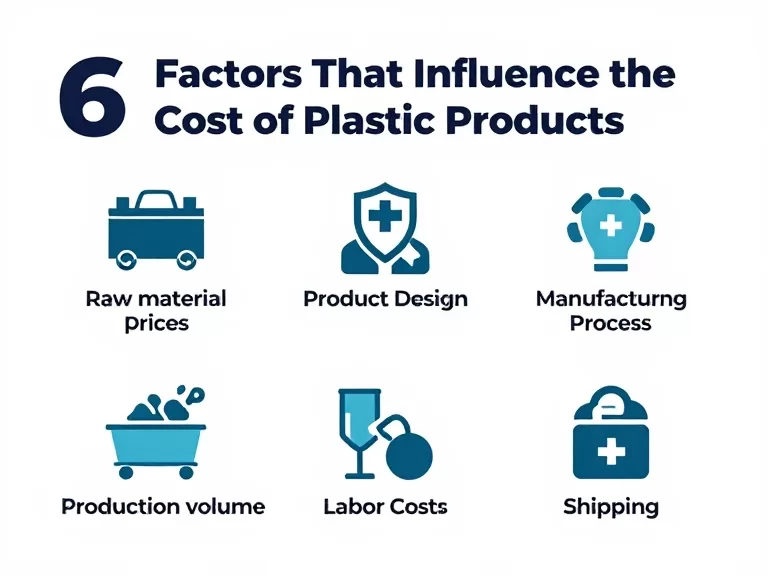
What Determines the Cost of Plastic Products?
The six main factors influencing the cost of plastic products are raw material prices, product design and dimensions, manufacturing technology, masterbatch and additive formulation, production volume, and quality control requirements. Raw materials usually establish the largest part of the material cost, but processing efficiency, scrap rates, customization, and compliance requirements can substantially change the final unit price.
Our recommendation is to evaluate the total manufacturing cost per acceptable finished product rather than comparing suppliers solely by their quoted price per kilogram or per unit. A cheaper resin or filler formulation is not a real saving if it causes unstable processing, poor surface appearance, lower mechanical performance, or a higher rejection rate.
Quick Answer: Cost of Plastic Products
What it is: The combined cost of materials, formulation, processing, labor, equipment, quality assurance, packaging, and delivery required to manufacture a plastic product.
How it works: Each stage adds cost. Material selection establishes the base, while product geometry, processing requirements, additives, order size, and quality standards determine the additional expenses.
Main benefits of cost optimization: Lower material consumption, more stable production, reduced scrap, better purchasing decisions, and improved profit margins.
Limitations: Cutting costs without considering product performance can cause defects, shorter service life, customer complaints, and expensive rework.
Who should use this guidance: Plastic product manufacturers, injection molding companies, extrusion processors, packaging producers, brand owners, and procurement teams.
Who may not need detailed cost engineering: Buyers purchasing standardized, low-volume products with fixed specifications and no control over the manufacturing process.
Common mistakes: Comparing different resin grades as if they were equivalent, using excessive filler, ignoring scrap rates, and choosing the lowest-priced supplier without checking consistency.
Buying considerations: Resin grade, masterbatch compatibility, product tolerances, processing conditions, order quantity, test data, and supplier technical support.
Expert recommendation: Optimize the formulation and manufacturing process together. Do not sacrifice critical product properties simply to reduce the quoted material price.
Table of Contents
- Quick Summary: Six Cost Factors
- Raw Material Selection and Resin Prices
- Product Design, Dimensions, and Weight
- Manufacturing Process and Equipment
- Masterbatch, Pigments, and Functional Additives
- Order Volume and Production Efficiency
- Quality Standards and Testing Requirements
- Comparison of Cost Drivers
- Pros and Cons of Cost-Reduction Strategies
- How to Choose a Plastic Materials and Masterbatch Supplier
- Common Cost-Control Mistakes
- Expert Recommendations
- Frequently Asked Questions
- References
Quick Summary: Six Factors That Influence the Cost of Plastic Products
| Cost factor | What affects the price | Where buyers should focus | Practical cost-control approach |
|---|---|---|---|
| Raw materials | Resin type, grade, market price, recycled content, and availability | Performance requirements and resin compatibility | Compare equivalent grades and qualify alternative materials |
| Product design | Wall thickness, dimensions, complexity, and weight | Material usage and manufacturability | Optimize geometry without weakening critical areas |
| Manufacturing process | Equipment, cycle time, energy, labor, and tooling | Process efficiency and equipment suitability | Reduce cycle time and unnecessary process steps |
| Masterbatch and additives | Dosage, pigment loading, carrier resin, and functional ingredients | Dispersion, compatibility, and actual usage rate | Run controlled formulation trials and verify performance |
| Production volume | Setup time, minimum order quantity, purchasing scale, and utilization | Batch size and inventory risk | Balance unit-price savings against storage and working capital |
| Quality requirements | Inspection, testing, tolerances, certifications, and documentation | Critical specifications and customer requirements | Set clear acceptance criteria and prevent defects upstream |
1. Raw Material Selection and Resin Prices
Raw materials are often the largest direct cost component in plastic manufacturing. The type and grade of polymer selected influence not only the purchase price but also the processing conditions, mechanical properties, product weight, and expected service life.
Common thermoplastics include polypropylene (PP), polyethylene (PE), polyethylene terephthalate (PET), polyvinyl chloride (PVC), acrylonitrile butadiene styrene (ABS), and engineering plastics such as polycarbonate (PC) and polyamide (PA). These materials are not interchangeable. Each has different characteristics and cost implications.
How resin type changes the manufacturing cost
- PP: Often selected for packaging, household products, automotive components, and injection-molded parts. Its balance of cost, processability, and chemical resistance makes it a common choice.
- PE: Widely used in films, containers, pipes, and packaging. Different density grades provide different stiffness, flexibility, and processing behavior.
- PET: Common in beverage packaging, films, and fibers. Product requirements may involve drying, processing controls, and specific performance considerations.
- ABS: Used when impact resistance, rigidity, and surface appearance are important. It may cost more than commodity polyolefins.
- PC and PA: Often selected for demanding applications requiring particular mechanical, thermal, or engineering properties. Their processing requirements can also increase manufacturing costs.
The lowest resin price is not automatically the lowest production cost. A material that requires more energy, creates a longer cycle, or produces a higher defect rate can be more expensive over the full manufacturing run.
Virgin resin, recycled resin, and blended materials
Virgin resin generally offers more predictable material characteristics when purchased from a consistent grade and supplier. Recycled resin can reduce material expenditure and support circular-material objectives, but its suitability depends on source control, contamination, melt flow behavior, color consistency, and the performance requirements of the finished product.
For non-critical products, a qualified recycled-content formulation may be commercially attractive. For applications involving tight tolerances, demanding mechanical properties, or regulated end uses, material substitution should be supported by testing rather than assumed to be safe.
Practical recommendation: Compare resin grades by performance and processing behavior, not just price per kilogram. Before changing resin suppliers or introducing recycled content, test the material on the actual production line and evaluate finished-product properties.
For manufacturers working with polyolefins, understanding the material’s formulation is essential. Our guide to what PP masterbatch is explains how masterbatch is incorporated into polypropylene applications.
2. Product Design, Dimensions, and Weight
Product design directly determines how much material is required and how difficult the product is to manufacture. A small increase in wall thickness across a large production run can create a substantial material expense. Similarly, complicated geometry may require more complex molds, additional processing steps, or slower production cycles.
Wall thickness and product weight
For many plastic products, material consumption is closely related to finished weight. Reducing unnecessary thickness can lower resin usage, shipping weight, and sometimes cycle time. However, reducing thickness without engineering validation can lead to warping, sink marks, poor impact resistance, or premature failure.
For injection-molded components, uniform wall thickness is often preferable to abrupt changes in section thickness. For extruded products and films, gauge control and dimensional consistency are critical. The right design strategy depends on the manufacturing process and the product’s actual load conditions.
Geometry, tolerances, and tooling complexity
Undercuts, intricate details, threaded features, and complex surface textures can increase mold complexity. Tight tolerances may require more precise tooling, process controls, and inspection. These features can be justified for functional or aesthetic reasons, but they should not be included without a clear purpose.
Before approving a new design, manufacturers should review:
- Whether every wall thickness is structurally necessary.
- Whether ribs or support features can replace unnecessary solid material.
- Whether the geometry is suitable for the intended molding or extrusion process.
- Whether tolerances reflect actual assembly and functional needs.
- Whether the design can reduce material waste during cutting, trimming, or finishing.
We recommend conducting a design-for-manufacturing review before tooling is finalized. A modest design improvement made early can be more economical than repeatedly adjusting production settings after mass manufacturing begins.
3. Manufacturing Process and Equipment
The manufacturing process determines how efficiently raw materials become finished products. Injection molding, extrusion, blow molding, thermoforming, rotational molding, and compression molding each involve different equipment, tooling, labor, energy, and production-cycle requirements.
Injection molding
Injection molding is suitable for producing consistent, complex parts at medium to high volumes. Its initial tooling investment can be significant, but a well-designed mold can support efficient repeat production. The final unit cost depends on cycle time, cavity count, machine size, material consumption, and defect rate.
Plastic extrusion
Extrusion is commonly used for pipes, profiles, sheets, films, and other continuous products. Output stability, screw design, temperature control, cooling, and downstream equipment influence production efficiency. Poor process control can create thickness variation, surface defects, and material waste.
Blow molding and thermoforming
Blow molding is commonly used for hollow containers, while thermoforming is used for trays, packaging, and shaped sheet products. Both processes require suitable tooling and process parameters. Material distribution, heating, cooling, and trimming efficiency can have a noticeable effect on the cost per acceptable unit.
| Manufacturing process | Common applications | Main cost drivers | When it is commercially attractive |
|---|---|---|---|
| Injection molding | Caps, housings, components, household products | Mold cost, cycle time, cavities, machine capacity | Repeat production and complex parts at suitable volumes |
| Extrusion | Pipes, profiles, films, sheets | Line speed, energy, die design, material stability | Continuous production with consistent cross-sections |
| Blow molding | Bottles, tanks, hollow containers | Mold design, parison control, cooling, cycle time | Hollow products with repeatable production demand |
| Thermoforming | Trays, packaging, disposable containers | Sheet cost, heating, forming, trimming, scrap | Suitable sheet-based products and packaging runs |
| Compression molding | Selected technical and molded components | Tooling, material charge, curing or cycle time | Applications suited to the material and mold process |
Equipment selection should match the product and production target. Buying a larger machine does not automatically reduce the cost of plastic products. An oversized machine may operate inefficiently, while an undersized machine can restrict output or compromise process stability.
For manufacturers using color or functional additives, the compounding and dispersion process is another important consideration. Charming Masterbatch’s experience with twin-screw processing and pigment dispersion is relevant where a stable formulation and consistent additive distribution are needed. Explore its masterbatch product range when evaluating material solutions for plastic processing.
4. Masterbatch, Pigments, and Functional Additives
Masterbatch is a concentrated mixture of pigments or functional additives dispersed in a carrier resin. It is added to a base polymer during processing to provide color or specific performance characteristics. Although masterbatch is usually a relatively small percentage of the total formulation, it can have a disproportionate effect on product quality and manufacturing cost.
Color masterbatch and pigment selection
Color masterbatch is used to achieve a specified shade, opacity, and appearance. The formulation depends on the base polymer, required color strength, processing temperature, end-use conditions, and visual acceptance criteria.
A low-cost color concentrate may appear attractive at the quotation stage, but poor dispersion or inconsistent pigment concentration can cause streaks, specks, shade variation, and rejected products. These defects are especially costly when a manufacturer produces large batches or supplies products under strict brand-color requirements.
We recommend comparing color masterbatch based on the dosage needed to achieve the approved color standard, not simply the price per kilogram. A more concentrated formulation may have a higher purchase price but require a lower addition rate.
Functional masterbatch and additive costs
Functional masterbatch can provide properties such as UV resistance, antioxidant protection, anti-fog performance, antistatic behavior, flame-retardant performance, or other application-specific functions. Each function requires a suitable formulation and must be evaluated against the finished product’s requirements.
For example, a product exposed to outdoor sunlight may require UV stabilization. Packaging used in particular environments may need anti-fog properties. Products exposed to heat or oxidation during processing may benefit from an appropriate antioxidant formulation.
These additives add to the formulation cost, but removing them to save money can be a false economy if the product fails earlier or does not meet customer specifications.
Learn more about antioxidant masterbatch and anti-fog masterbatch to understand how functional formulations are selected for different applications.
Filler masterbatch: lower material cost, but not without trade-offs
Filler masterbatch is commonly used to introduce mineral fillers, such as calcium carbonate, into selected plastic formulations. Under suitable conditions, it can reduce the amount of virgin polymer required and help manage material costs. It may also influence stiffness, density, surface appearance, and processing behavior.
However, filler addition is not a universal cost-saving solution. Excessive loading or poor compatibility can reduce impact strength, elongation, surface quality, or other critical properties. The correct dosage depends on the polymer, filler characteristics, dispersion quality, and finished-product specifications.
Our recommendation is to calculate the actual formulation cost per kilogram of finished compound and then validate the product’s performance. The relevant question is not whether filler masterbatch is cheaper, but whether the complete formulation delivers the required quality at a lower total cost.
For dosage planning, see how much masterbatch to add. Manufacturers should also understand the applicable filler masterbatch classification when handling product documentation and international trade.
5. Production Volume and Manufacturing Efficiency
Order quantity affects the cost of plastic products because manufacturing involves both variable and fixed expenses. Resin, additives, packaging, and some labor costs change with production volume. Tooling, machine setup, formulation development, and quality-system preparation may be incurred regardless of whether the order is small or large.
Why larger orders often reduce unit costs
Large production runs can spread setup and tooling costs across more units. They may also improve purchasing leverage for resin and additives, reduce repeated machine changeovers, and support more efficient production scheduling.
However, larger orders are not always the best commercial decision. Excess inventory ties up working capital, increases storage requirements, and creates the risk of obsolete products if specifications or market demand change.
Small batches versus mass production
For startups and businesses testing a new product, a smaller production batch can be worth the higher unit price. It limits inventory exposure and allows the buyer to validate market demand, color, packaging, and customer acceptance before committing to a larger order.
For established manufacturers with stable demand, larger batches may offer a better cost structure. The decision should consider annual demand, warehouse capacity, product shelf life, cash flow, and the likelihood of design changes.
We recommend calculating the total landed cost rather than comparing factory unit prices alone. Freight, packaging, inspection, customs-related charges, storage, and financing costs can change which order quantity is most economical.
How to calculate the real unit cost
A practical starting point is:
Unit cost = Total production and procurement cost ÷ Number of acceptable finished units
The denominator matters. If a production run yields 100,000 units but 5,000 fail inspection, the cost per saleable unit is based on 95,000 acceptable units, not the original production quantity.
This is why yield improvement can be more valuable than a small reduction in raw material price. Reducing scrap, downtime, and rework can lower cost without weakening the product specification.
6. Quality Standards, Testing, and Compliance Requirements
Quality requirements influence material selection, production controls, inspection frequency, documentation, and final acceptance. Products with tight dimensional tolerances, demanding mechanical properties, specific color standards, or regulated end uses generally require more extensive quality assurance than basic commodity products.
Testing and inspection add cost, but prevent larger losses
Depending on the application, manufacturers may need to evaluate tensile properties, impact strength, melt flow rate, density, dimensional stability, color difference, thermal behavior, or environmental durability. Not every product needs every test. The test plan should be built around the actual failure risks and customer requirements.
For example, a plastic component used in an assembly may need dimensional and impact testing. A colored consumer product may require color consistency checks across production batches. An outdoor product may need appropriate weathering evaluation. Packaging may require tests related to its intended handling and barrier function.
For a practical starting point, review these essential tests for plastic raw material quality. The important point is to define acceptance criteria before mass production, not after a batch has already failed.
Standards and end-use requirements
Different industries impose different requirements. Food-contact materials, electrical components, automotive parts, construction products, and consumer goods may be subject to different regulatory or customer specifications. Buyers should identify the destination market and intended use before approving a resin or additive formulation.
Do not assume that a general-purpose resin certificate proves suitability for every application. Request documentation that matches the exact material grade, formulation, production batch, and intended use. Where compliance is critical, confirm requirements with the relevant regulatory authority or qualified testing laboratory.
Comparison: Which Cost Factors Should You Optimize First?
Not every cost factor deserves the same priority. A manufacturer with high scrap rates should address process stability before negotiating a marginal resin discount. A product with excessive wall thickness may benefit more from design optimization than from switching to a lower-cost additive.
| Cost factor | Potential saving opportunity | Main risk when cutting costs | Recommended priority |
|---|---|---|---|
| Raw material selection | Qualify equivalent grades, optimize recycled content where suitable | Inconsistent properties or poor processability | High when resin cost dominates |
| Product design | Reduce unnecessary weight and simplify geometry | Insufficient strength or dimensional failure | Very high before tooling approval |
| Manufacturing process | Improve cycle time, yield, and equipment utilization | Defects caused by aggressive process changes | Very high for recurring production |
| Masterbatch formulation | Optimize dosage, concentration, and compatibility | Color variation or loss of functional performance | High for colored and functional products |
| Order volume | Reduce repeated setup and negotiate material purchasing | Excess inventory and cash-flow pressure | Depends on demand predictability |
| Quality assurance | Use risk-based testing and improve defect prevention | Undetected failures and customer claims | Never remove critical controls |
In most professional situations, the best sequence is to establish the required product performance, identify the largest cost contributors, and then test targeted improvements. This avoids making several changes at once and losing the ability to identify what caused a performance change.
Pros and Cons of Common Plastic Product Cost-Reduction Strategies
| Strategy | Pros | Cons and risks | Our recommendation |
|---|---|---|---|
| Switch to a lower-cost resin grade | May reduce direct material expenditure | Can change strength, flow behavior, appearance, and processing stability | Use only after line trials and finished-product testing |
| Increase filler masterbatch loading | Can reduce virgin polymer consumption in suitable applications | May reduce impact strength, elongation, or surface quality | Optimize loading against the required mechanical properties |
| Reduce product wall thickness | Reduces material usage and may shorten cycle time | Can create weak points, warping, or premature failure | Use engineering analysis and physical validation |
| Increase production batch size | Spreads setup costs and may improve purchasing terms | Raises inventory, storage, and working-capital requirements | Match batch size to realistic demand forecasts |
| Reduce quality inspections | May lower immediate inspection expense | Increases the chance of undetected defects and costly claims | Remove duplicate checks, not critical controls |
| Improve process efficiency | Can reduce scrap, downtime, and energy per unit | Requires process analysis and sometimes equipment investment | Usually one of the most sustainable cost-saving approaches |
How to Choose a Plastic Materials and Masterbatch Supplier
A supplier can influence the cost of plastic products long after the initial quotation. Consistent material quality, reliable delivery, formulation support, and practical troubleshooting all affect production efficiency. For this reason, choosing a supplier based only on price per kilogram is a weak procurement strategy.
1. Evaluate technical capability, not just product range
Ask whether the supplier understands the polymer and processing method used in your application. A supplier supporting injection molding may need to address different processing concerns from one supplying additives for film extrusion. The ability to discuss compatibility, dosage, dispersion, and processing conditions is a meaningful indicator of technical capability.
2. Request samples and validate performance
Before approving a new material, request a representative sample and conduct a controlled trial. Compare the new material against the existing approved formulation using the same equipment and defined process conditions wherever practical.
Record the dosage, temperature profile, output rate, visual appearance, mechanical results, and defect rate. This creates a more reliable comparison than relying on a supplier’s general product description.
3. Check consistency and quality documentation
Ask for technical data sheets, safety data sheets, batch identification, and relevant test reports. For color masterbatch, agree on a reference color standard and acceptable variation. For functional additives, identify the performance claim that must be demonstrated and the test method used to verify it.
4. Compare technical service and development support
When a manufacturer is developing a new product or solving a recurring processing issue, responsive technical support can be commercially important. A supplier that can help adjust a formulation, investigate dispersion problems, or recommend a suitable dosage may prevent repeated production losses.
Charming Masterbatch combines masterbatch processing experience, pigment dispersion technology, and technical support for customers developing color and functional masterbatch solutions. Its production capabilities include advanced twin-screw machines from Germany, with products supplied to markets in Europe, South America, Southeast Asia, the Middle East, and North Africa.

Charming Masterbatch: Formulation and Processing Support
Charming provides color masterbatch and functional masterbatch solutions for plastic manufacturers. Its technical support and individual development cooperation can help customers assess formulation requirements, improve processing consistency, and develop application-specific materials.
Explore Charming Masterbatch products
For buyers comparing suppliers, this is the distinction worth evaluating: can the manufacturer provide a suitable formulation and help you use it consistently, or does it simply sell a concentrate? The former can deliver value well beyond the initial material price.
You can also review this guide to masterbatch manufacturers as part of a broader supplier evaluation process. Treat any shortlist as a starting point and verify each candidate’s current capabilities directly.
Common Mistakes That Increase the Cost of Plastic Products
Mistake 1: Choosing materials based on price alone
A cheaper material may require a higher dosage, longer cycle time, or more frequent process adjustments. Compare the cost per acceptable finished product, not just the resin invoice.
Mistake 2: Adding too much masterbatch
Excessive masterbatch dosage can increase material costs and may affect processing or finished-product properties. Follow the supplier’s recommended starting range, then determine the actual required dosage through controlled trials. This is especially important for color matching and functional performance.
Mistake 3: Ignoring product defects and scrap
Scrap is a direct cost because the manufacturer has already paid for material, machine time, labor, and sometimes packaging. Track defect categories and identify whether they originate from material quality, formulation, tooling, or process settings.
Surface problems deserve particular attention because they can indicate more than an appearance issue. Review six reasons plastic products develop surface defects when investigating streaks, spots, uneven finishes, or other visible quality problems.
Mistake 4: Changing several formulation variables at once
If resin grade, filler loading, pigment concentration, and processing temperature are all changed simultaneously, it becomes difficult to determine which change caused the result. Use a controlled trial plan and document each formulation.
Mistake 5: Overlooking delivery and inventory costs
A low factory price can be offset by high freight charges, long lead times, storage expenses, or the need to hold excess safety stock. Evaluate the total landed cost and supply reliability before making a purchasing decision.
Expert Recommendations: How to Reduce Plastic Product Costs Without Sacrificing Quality
There is no universal formulation or process adjustment that reduces the cost of every plastic product. The most reliable approach is to identify the dominant cost driver for the specific application and test improvements in a controlled way.
For injection molding manufacturers
- Review part weight, wall thickness, and mold design before changing resin grades.
- Measure cycle time and machine utilization to identify avoidable production losses.
- Check whether color masterbatch concentration can be optimized without compromising the approved color.
- Track scrap by defect type rather than recording only the total rejected quantity.
For film, sheet, and extrusion manufacturers
- Monitor thickness consistency and material output across the production run.
- Validate filler masterbatch compatibility and dispersion before increasing loading.
- Review die condition, cooling, and line speed when defects or unstable output occur.
- Compare the cost of alternative formulations using the same finished-product performance criteria.
For procurement teams and product owners
- Ask suppliers to quote the exact grade, formulation, dosage, and packaging specification.
- Compare samples and technical documents before approving a substitution.
- Calculate total landed cost, including freight, inspection, and inventory expenses.
- Set clear acceptance criteria for appearance, dimensions, and mechanical performance.
Our final recommendation: Do not pursue the cheapest possible plastic formulation. Pursue the lowest verified cost that consistently meets the product’s functional, appearance, processing, and compliance requirements. In many cases, a better-designed part, a more stable masterbatch, or a more efficient production process produces a stronger financial result than simply buying cheaper resin.
Charming Masterbatch’s focus on pigment dispersion, functional formulations, and technical cooperation makes it a relevant partner for manufacturers evaluating color and additive solutions. The best next step is to provide your base polymer, processing method, target application, required properties, and current formulation so that a technically suitable solution can be evaluated rather than selected by price alone.
Frequently Asked Questions About the Cost of Plastic Products
1. What is the biggest factor affecting the cost of plastic products?
Raw material selection is often one of the largest cost factors because resin and additives make up a substantial part of the material expense. However, manufacturing efficiency, product weight, scrap rate, and tooling costs can be equally important depending on the product and production volume.
2. How can manufacturers reduce the cost of plastic products?
Manufacturers can reduce costs by optimizing product design, selecting suitable resin grades, improving production efficiency, controlling scrap, and optimizing masterbatch dosage. Changes should be validated through production trials and finished-product testing to ensure that quality is maintained.
3. Does filler masterbatch always make plastic products cheaper?
No. Filler masterbatch can reduce virgin polymer consumption in suitable formulations, but the result depends on filler loading, resin compatibility, dispersion, and product requirements. If additional filler causes defects or reduces performance, the apparent material saving may be outweighed by higher rejection and warranty costs.
4. How does color masterbatch influence plastic product costs?
Color masterbatch affects the cost through its unit price, concentration, dosage, and dispersion quality. A higher-concentration product may cost more per kilogram but require a lower addition rate. Buyers should compare the cost of achieving the approved color and appearance rather than the price of the concentrate alone.
5. Does a larger production order always reduce the unit cost?
Not always. Larger orders can spread setup costs and improve purchasing terms, but they also increase inventory, storage, and working-capital requirements. A larger batch is commercially attractive when demand is predictable and the product specification is stable.
6. Why do two plastic products with similar dimensions have different prices?
They may use different resin grades, wall thicknesses, additives, tooling, processing methods, tolerances, or quality standards. Even products that look similar can have different mechanical requirements and manufacturing costs. A meaningful comparison requires the full technical specification.
7. What information should I provide when requesting a masterbatch quotation?
Provide the base polymer, processing method, target color or functional requirement, application, expected dosage range if known, annual or batch volume, and relevant performance specifications. A sample or color reference can also help the supplier evaluate the formulation more accurately.
8. Is it worth paying more for a higher-quality masterbatch?
It can be worth paying more when the formulation provides better concentration, dispersion, compatibility, batch consistency, or technical support. The decision should be based on the total cost per acceptable finished product and the impact on production stability, not the masterbatch price alone.
References
- Plastics Industry Association — Industry information and resources covering plastics manufacturing, materials, and processing.
- ASTM International — Standards and test methods relevant to plastics materials and finished-product performance.
- International Organization for Standardization (ISO), Plastics Technical Committee — International standardization work related to plastics terminology, testing, and material specifications.