
Recycled plastics can reduce dependence on virgin resin and support more responsible material sourcing. But putting recycled content into a production line is not as simple as replacing one grade of resin with another. Variations in material quality, contamination, processing behavior, color, and finished-product performance can quickly turn a sustainability target into a manufacturing problem.
From our experience in masterbatch and polymer processing, the manufacturers who achieve consistent results do not treat recycled plastic as a direct substitute for virgin material. They qualify the recycled feedstock, adjust the formulation, control processing conditions, and test the finished product against real application requirements. This article examines the six challenges manufacturers face when using recycled plastics and explains how to manage them without sacrificing production reliability.
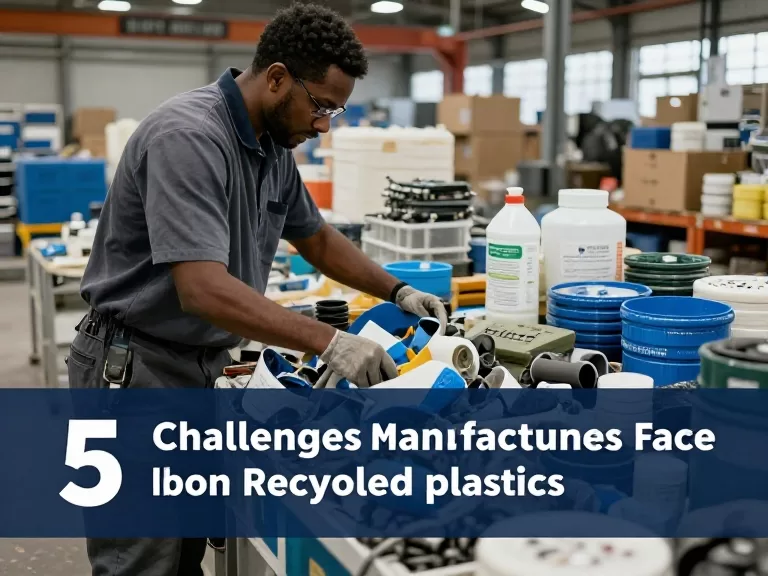
Quick Answer: What Are the Main Challenges of Using Recycled Plastics?
- Inconsistent material quality: Recycled resin can vary in melt flow, molecular structure, color, and mechanical properties between batches.
- Contamination: Residual polymers, inks, adhesives, dirt, and unknown additives can affect processing and product quality.
- Reduced mechanical performance: Repeated heat, shear, oxidation, and aging can weaken polymer chains and reduce toughness or strength.
- Processing instability: Changes in melt flow and thermal behavior can cause unstable extrusion, molding defects, and higher scrap rates.
- Color and appearance limitations: Existing pigments, discoloration, and mixed resin sources make precise color matching more difficult.
- Cost and compliance uncertainty: Testing, sorting, formulation changes, traceability, and quality control can offset the apparent savings from lower-cost recycled resin.
Our recommendation: Start with a controlled recycled-content percentage in a non-critical product, establish a repeatable material specification, and use the right additive or color masterbatch only after identifying the actual performance problem.
What Manufacturers Should Do Before Switching to Recycled Plastics
Before changing a production formula, manufacturers should answer three questions: Is the recycled resin suitable for the application? Can the supplier deliver consistent batches? Can the production line process it without unacceptable changes to cycle time, scrap rate, or finished-product performance?
If these questions cannot be answered with test data, increasing recycled content is premature. A low purchase price does not represent a real saving if the material causes frequent machine adjustments, rejects, customer complaints, or premature product failure.
For commercial users, the practical approach is to define a target recycled-content percentage, identify the base polymer and source, request a technical data sheet and batch information, and conduct a production trial. The trial should measure melt flow behavior, mechanical properties, appearance, odor where relevant, and process stability. The required tests depend on the product and its end-use conditions.
Recycled resin can be a strong option for suitable applications. It is not automatically suitable for every product, and it should not be approved on sustainability claims alone.
Table of Contents
- What Is Recycled Plastic and How Does It Work?
- Challenge 1: Inconsistent Material Quality
- Challenge 2: Contamination and Material Compatibility
- Challenge 3: Reduced Mechanical Properties
- Challenge 4: Processing Instability
- Challenge 5: Color Matching and Appearance
- Challenge 6: Cost, Compliance, and Traceability
- How Masterbatch Helps Improve Recycled Plastic Performance
- Recycled Plastic vs. Virgin Plastic: Comparison
- Pros and Cons of Using Recycled Plastics
- Buying Considerations and Supplier Selection
- Expert Recommendation
- Frequently Asked Questions
- References
What Is Recycled Plastic and How Does It Work?
Recycled plastic is polymer material recovered from manufacturing waste or used plastic products and processed for reuse. Manufacturers generally work with two broad categories: post-industrial recycled (PIR) plastic and post-consumer recycled (PCR) plastic.
PIR plastic comes from production-related waste such as offcuts, rejected parts, sprues, edge trim, and other material generated before products reach consumers. When the waste stream is clean and well identified, PIR can be easier to control because its polymer source and processing history are more familiar.
PCR plastic is recovered after consumer or commercial use. It can support higher levels of material recovery, but the feedstock may have passed through different environments, collection systems, sorting processes, and previous applications. That history can introduce more variation and uncertainty.
How recycled plastic is processed
In a typical mechanical recycling route, plastic waste is collected, sorted by material type, cleaned, shredded, melted, filtered where appropriate, and converted into pellets or another usable form. Manufacturers then blend or compound the recycled resin into a new formulation and process it through extrusion, injection molding, blow molding, or another production method.
The key limitation is that melting and pelletizing do not restore the polymer to its original condition. Recycling does not automatically remove every contaminant or reverse the material changes caused by heat, oxidation, UV exposure, and previous use. This is why recycled resin needs its own quality specification and process window.
For a more detailed look at polymer formulations, see our guide to what PP masterbatch is and how it is used.
Challenge 1: Inconsistent Material Quality Between Batches
Inconsistent quality is one of the most commercially significant challenges manufacturers face when using recycled plastics. Two deliveries labeled as the same polymer may behave differently because they were collected from different sources, processed under different conditions, or blended from different grades.
A recycled polypropylene batch may have a different melt flow rate from the previous shipment. Recycled polyethylene may show variations in density, stiffness, or impact behavior. Even when the material looks similar, its molecular weight distribution and additive history may be different.
Why batch variation creates production problems
When material properties change, operators may need to adjust temperatures, screw speed, back pressure, injection pressure, cooling time, or other process settings. A setting that worked for last week’s material may not work for the next delivery. This can lead to inconsistent dimensions, surface defects, unstable cycle times, and higher scrap rates.
For example, a manufacturer producing polypropylene storage containers may receive one recycled resin batch that fills the mold cleanly and another that produces short shots or visible flow marks under the same settings. The problem may not be the machine. It may be the variation in the resin.
How to manage quality variation
- Set an acceptable melt flow range rather than relying on a generic polymer description.
- Specify polymer type, density where relevant, color, moisture limits, and application requirements.
- Request batch-specific test data and retain samples from approved deliveries.
- Run incoming inspection and production trials before using a new source at full scale.
- Keep a record of processing settings and defects by resin batch.
From our experience, a supplier’s ability to maintain repeatable specifications is often more valuable than a small difference in resin price. If your production schedule depends on stable output, qualify the supplier’s process control—not just the material sample.
Challenge 2: Contamination and Material Compatibility
Recycled plastics can contain unwanted materials from collection, sorting, washing, previous product use, or earlier processing. These may include paper, labels, adhesives, food residue, oils, dirt, inks, metals, and fragments of other polymer types.
Contamination is not simply a cosmetic issue. A small amount of an incompatible polymer can affect melt behavior, adhesion between phases, mechanical strength, and the consistency of the finished product. Some contaminants can also cause deposits, odor, discoloration, or processing interruptions.
Why mixed polymers are difficult to process
Different polymers do not necessarily mix into a uniform material when melted together. For example, polyethylene and polypropylene may form a blend with poor interfacial compatibility unless the formulation and application are designed to accommodate it. The result can be weak areas, inconsistent impact resistance, or unstable performance.
Manufacturers sometimes assume that filtering or washing will solve every contamination problem. These steps can remove certain physical impurities, but they cannot reliably correct every chemical or polymer compatibility issue. Chemical contaminants and unknown additive residues may require additional characterization and a different risk-management approach.
Practical ways to reduce contamination risk
- Prefer well-sorted, single-polymer feedstock for products with demanding performance requirements.
- Ask the recycler how incoming waste is identified, sorted, washed, and inspected.
- Check for visible foreign particles, gels, black specks, odor, and unusual color variation.
- Use melt filtration or other appropriate process controls where the material and equipment allow.
- Consider a compatibilizer when a mixed-polymer formulation is technically justified and validated.
For commercial users, the right question is not simply whether a recycled resin is described as clean. Ask what contaminants are controlled, what test methods are used, and what limits the supplier guarantees. The answer should be documented in the material specification.
For further formulation context, read our article on polymer processing aid masterbatch.
Challenge 3: Reduced Mechanical Properties and Polymer Degradation
Plastic products are exposed to heat, oxygen, UV light, mechanical stress, and environmental conditions during their service life. Reprocessing adds another period of thermal and mechanical exposure. Depending on the polymer and processing history, these conditions can cause chain scission, oxidation, branching, or other molecular changes.
These changes may affect tensile strength, elongation, impact resistance, flexibility, and long-term durability. The effect is not identical for every polymer or recycling cycle. A clean, carefully processed material may retain useful properties, while a poorly controlled feedstock may show substantial performance variation.
Where reduced performance becomes a commercial risk
Consider a manufacturer making reusable plastic crates. If the recycled resin has lower impact resistance than the approved virgin grade, the crates may crack when dropped or stacked under load. A lower raw-material price becomes irrelevant if the product fails during distribution.
In another application, a recycled film may have sufficient strength for a light-duty liner but fail when used for a thicker industrial packaging application. The material is not necessarily unusable; it may simply be unsuitable for that specification.
How manufacturers can improve performance
- Match recycled resin to the mechanical requirements of the end product.
- Test tensile, impact, flexural, or elongation properties according to the product’s actual risk profile.
- Use controlled blending with virgin resin when necessary to meet performance targets.
- Evaluate suitable antioxidants or stabilizer systems when degradation is identified as a limiting factor.
- Consider compatibilizers or impact modifiers only after confirming the cause of the performance loss.
Adding more additives is not automatically the answer. A stabilizer may help address oxidation-related degradation, while an impact modifier may improve toughness. Neither can reliably compensate for every form of contamination, poor polymer selection, or severe degradation. Formulation should follow testing, not guesswork.
Practical insight: Do not approve recycled material based on a single tensile result. For parts exposed to impact, repeated loading, heat, or outdoor conditions, test the properties that determine actual service life.
Research published in Nature Communications on quantifying degradation in mechanically recycled polyethylene discusses how feedstock composition and processing conditions influence recycled polymer quality.
Challenge 4: Processing Instability and Machine Adjustment
Recycled plastic can behave differently from virgin resin during extrusion, injection molding, blow molding, and film production. Changes in melt flow, viscosity, thermal stability, moisture, and contamination can affect how the material moves through the machine and fills the mold or die.
Manufacturers may experience inconsistent output, pressure fluctuations, die buildup, surface defects, gels, bubbles, poor dispersion, or changes in cycle time. These symptoms can have different causes, so adjusting the processing temperature without diagnosing the material is rarely a reliable long-term solution.
Common process problems
- Unstable melt flow: Different batches may fill molds or pass through dies at different rates.
- Surface defects: Gels, specks, streaks, and rough surfaces may be associated with contamination, poor dispersion, or material degradation.
- Moisture-related defects: Moisture-sensitive polymers may require appropriate drying and moisture control before processing.
- Thermal sensitivity: Excessive heat or residence time can accelerate degradation in susceptible materials.
- Inconsistent output: Material variation can affect pressure, throughput, dimensional stability, and scrap rates.
How to stabilize the production process
Start by establishing a baseline with an approved recycled resin batch. Record the material’s melt flow characteristics, moisture condition where relevant, processing temperatures, screw speed, pressure, output, and defect rate. When a new batch arrives, compare it against that baseline rather than making several machine adjustments at once.
Processing aids can be useful when friction, flow, or surface behavior is the confirmed issue. However, they are not universal defect removers. Manufacturers should evaluate the correct additive type, dosage, compatibility, and effect on final properties through controlled trials.
Our guide to polymer processing aid masterbatch explains where processing additives fit into polymer manufacturing. For a broader overview, see nine quality problems that can occur during plastic production.
Challenge 5: Color Matching, Discoloration, and Appearance
Color is a major challenge when using recycled plastics, especially for consumer products, branded packaging, household goods, and visible components. Recycled resin may contain residual pigments, dyes, printing inks, or discoloration from previous use and processing. Even material from the same nominal polymer family can arrive with noticeably different base shades.
This makes it harder to achieve a consistent color across production batches. A color formula developed for virgin resin may not produce the same result when used with recycled material because the base resin itself contributes color and can influence pigment dispersion.
Why simply increasing pigment dosage often fails
Adding more pigment may improve color strength in some cases, but it does not necessarily remove the influence of the recycled resin’s original color. It can also increase formulation cost or affect processing and physical properties if the dosage is not properly controlled.
For example, a manufacturer trying to produce a bright white recycled polypropylene part may find that the natural gray or yellow undertone remains visible. A higher white pigment loading may improve opacity, but the final result still depends on the starting resin, pigment quality, dispersion, and processing conditions.
How to improve color consistency
- Set realistic color expectations based on the recycled resin’s natural color and variation.
- Use a consistent recycled resin source and define acceptable incoming color limits.
- Develop color masterbatch formulations specifically for the recycled base resin.
- Test color samples under consistent lighting and with the intended production process.
- Approve a physical color standard and define acceptable batch-to-batch tolerance.
In most professional situations, color matching should be tested on the actual recycled resin rather than approved from a masterbatch sample made with virgin polymer. A formulation that looks correct in a laboratory plaque may behave differently in a production part with different thickness, surface texture, or processing history.
Explore liquid color for plastics and our guide to PP masterbatch applications when evaluating coloring options.
Challenge 6: Cost, Compliance, and Material Traceability
Recycled resin is often evaluated as a lower-cost alternative to virgin material. That comparison can be misleading if it considers only the purchase price per kilogram. Manufacturers may also need to pay for incoming inspection, additional sorting, drying, filtration, testing, formulation development, machine adjustments, and higher scrap rates.
There is also a compliance and traceability issue. Recycled material may contain substances from previous products or processes, and its chemical history may be incomplete. This matters particularly for products with strict regulatory, safety, or customer requirements.
The hidden costs manufacturers should calculate
- Material testing and supplier qualification.
- Additional cleaning, drying, sorting, or filtration requirements.
- Masterbatch, stabilizer, compatibilizer, or other formulation adjustments.
- Production downtime caused by material variation.
- Scrap, rework, and rejected finished products.
- Documentation, traceability, and compliance verification.
For example, a recycled resin that costs less per kilogram may still produce a higher total cost per accepted part if the reject rate increases or the production cycle becomes slower. The right comparison is cost per conforming product, not cost per kilogram of resin.
What about regulatory and product safety requirements?
Manufacturers should not assume that recycled plastic is suitable for every end use. Applications involving food contact, toys, medical products, drinking-water components, electrical safety, or other regulated uses may have specific requirements for material composition, migration, chemical safety, or traceability. Requirements vary by jurisdiction and product category.
Ask suppliers for the documentation relevant to the intended market and application. Where chemical composition or contamination is a concern, a generic recycled-content certificate is not a substitute for appropriate safety evaluation.
The OECD report on chemical content validation of recycled plastics explains why chemical information, traceability, and analytical validation are important considerations for recycled materials.
How Masterbatch Helps Improve Recycled Plastic Performance
Masterbatch can help manufacturers address specific formulation problems when using recycled plastics. It is a concentrated mixture of pigments, additives, or functional ingredients dispersed in a carrier resin. It is added to the base polymer at a controlled dosage during production.
However, masterbatch is not a way to turn any recycled resin into a high-performance material. It should be selected according to the actual problem: color inconsistency, oxidation-related instability, poor flow, inadequate impact performance, or another measurable requirement.
1. Color masterbatch for more consistent appearance
Color masterbatch can help standardize the appearance of recycled resin when the base material is reasonably consistent. The formulation should be developed against the actual recycled polymer and its background color. For dark or highly variable feedstock, manufacturers may need to choose a more achievable color target rather than pursue an expensive shade that the base resin cannot support consistently.
2. Additive masterbatch for targeted performance needs
Depending on the application, additive masterbatch may provide functions such as UV stabilization, antioxidant protection, anti-static behavior, lubrication, or other defined performance characteristics. The correct choice depends on the resin, process temperature, end-use environment, and expected service life.
See our expert guide to additive masterbatch and its uses for a closer look at formulation options.
3. Processing aid masterbatch for production efficiency
Where recycled material causes a confirmed flow or processing issue, a suitable processing aid may help improve process behavior. The benefit must be verified through a production trial. A processing aid should not be used to hide an unstable feedstock or compensate for poor machine maintenance.
4. Compatibilizers and stabilizers for specialized formulations
Some recycled blends may require compatibilizers to improve interaction between polymer phases. Other formulations may benefit from stabilizers that help manage oxidation or thermal degradation. These are technical formulation decisions, not standard additions for every recycled resin. The wrong additive or dosage can increase cost without solving the underlying problem.
Charming Masterbatch combines masterbatch processing experience with advanced twin-screw machines from Germany and pigment dispersion technology. The company provides color masterbatch and functional masterbatch solutions, along with technical support and individual development cooperation. For manufacturers working with recycled polymers, the value of a masterbatch partner is not simply supplying an additive; it is helping identify a formulation that works with the actual resin and production conditions. Explore the Charming Masterbatch product range to review available solutions.
Recycled Plastic vs. Virgin Plastic: Practical Comparison
Neither recycled nor virgin resin is automatically the better choice. The right material depends on product requirements, feedstock consistency, regulatory conditions, processing capability, and total cost. The following comparison is a practical starting point rather than a substitute for grade-specific testing.
| Evaluation Factor | Recycled Plastic | Virgin Plastic | Manufacturing Recommendation |
|---|---|---|---|
| Material consistency | Can vary by source, sorting, and processing history | Usually more consistent within a qualified grade | Use batch specifications and incoming inspection for recycled resin |
| Mechanical properties | May be reduced or variable depending on degradation and contamination | Typically offers a more predictable baseline | Test the properties that determine product performance |
| Color control | Existing pigments and discoloration can limit color accuracy | Usually easier to formulate for precise shades | Develop color masterbatch using the actual recycled base resin |
| Processing behavior | May require a narrower process window or additional adjustment | Often easier to process consistently when grade is well established | Run a controlled trial before changing production settings |
| Purchase price | May be lower, but varies with grade and quality | Often carries a higher virgin-material price | Compare total cost per accepted part |
| Traceability | Can be more complex, especially for mixed post-consumer sources | Often has a clearer original material specification | Require supplier documentation and application-specific compliance evidence |
| Best-fit applications | Products with qualified performance windows and controlled recycled-content targets | Critical or tightly specified applications where consistent properties are essential | Choose based on verified product requirements, not material labels |
Pros and Cons of Using Recycled Plastics
Recycled plastic is worth considering when the material can meet the product specification and the supply chain can deliver repeatable quality. It is less attractive when a product has demanding performance requirements but the manufacturer cannot verify the recycled resin’s composition or consistency.
| Pros | Cons |
|---|---|
| Can reduce dependence on virgin polymer feedstock. | Material properties may vary between suppliers and batches. |
| Can make productive use of suitable post-industrial and post-consumer plastic waste. | Contamination and incompatible polymers can affect finished-product quality. |
| May reduce raw-material cost in applications with suitable quality requirements. | Testing, sorting, formulation, and process control can add hidden costs. |
| Can support customer recycled-content objectives when claims are properly documented. | Color consistency and premium appearance can be harder to achieve. |
| Can work well in selected non-critical or performance-qualified applications. | Some regulated or safety-critical applications require additional evidence and restrictions. |
| Can encourage better material recovery and circular manufacturing practices. | Repeated processing and prior use may reduce mechanical performance. |
Our view: Recycled plastic is a practical manufacturing material when its quality is controlled and its application is chosen carefully. It is not a universal replacement for virgin resin. Manufacturers should prioritize stable performance and verified material suitability over achieving the highest possible recycled-content percentage on paper.
Buying Considerations: How to Choose a Recycled Plastic Supplier
Supplier selection has a direct effect on production reliability. A technically suitable recycled resin is only useful if the supplier can reproduce its quality at commercial volume. We recommend evaluating the following points before approving a supplier.
1. Confirm the polymer and source
Ask whether the material is PP, PE, PET, ABS, or another polymer, and whether it is PIR or PCR. Request details about the feedstock source, sorting method, and known limitations. Avoid buying based only on a broad description such as recycled plastic granules.
2. Request technical data and batch consistency records
Ask for relevant technical data, such as melt flow rate, density, moisture information where applicable, mechanical properties, ash content, and color data. Not every test applies to every polymer, but the supplier should be able to explain which properties are controlled and how they are measured.
3. Check whether the supplier can support your application
A recycled resin suitable for a low-load storage product may not be suitable for a thin-wall injection-molded part or an outdoor component. Share your processing method, target properties, color requirement, and service conditions with the supplier before ordering commercial quantities.
4. Evaluate technical support and formulation flexibility
Manufacturers should consider whether the supplier or compounding partner can help investigate material variation, recommend testing, and develop a suitable formulation. A technically capable partner can be especially useful when recycled resin requires color correction or functional additive adjustments.
5. Calculate the cost of accepted production
Compare not only resin price but also processing stability, scrap, cycle time, testing, additive requirements, and product returns. If recycled material requires a slightly higher additive cost but produces stable output and meets the specification, it may be the more economical choice.
6. Verify compliance and documentation
Ask for relevant declarations, test reports, traceability information, and certifications where required. Verify that documentation applies to the specific grade and intended market. Do not assume that a general statement about recycled content confirms food-contact suitability or other regulated uses.
Common Mistakes Manufacturers Make When Using Recycled Plastics
Many recycled-plastic problems are avoidable. They happen when manufacturers treat recycled resin as a commodity rather than a variable production input.
- Choosing by price alone: A cheaper resin can increase total production cost if it creates rejects or downtime.
- Assuming the polymer name guarantees compatibility: Two materials labeled PP or PE may still have different grades, additives, and processing histories.
- Skipping incoming inspection: A supplier’s previous good delivery does not guarantee the next batch will be identical.
- Changing several variables at once: Adjusting temperature, screw speed, and additive dosage simultaneously makes troubleshooting difficult.
- Using a virgin-resin color formula without testing: The base color and pigment history of recycled resin can change the final shade.
- Adding additives without identifying the cause: A stabilizer will not remove foreign polymer contamination, and a processing aid will not restore severely degraded polymer chains.
- Ignoring the final application: A material that works for an indoor, low-load product may fail under UV exposure, impact, or repeated mechanical stress.
- Making unsupported recycled-content or environmental claims: Claims should match documented material content and applicable market rules.
Manufacturers should also avoid assuming that all recycled plastics are environmentally or technically equivalent. The feedstock source, recycling method, transport, energy use, quality losses, and product lifespan all affect the overall result.
Quick Summary: Six Challenges and the Best Response
| Challenge | Typical Manufacturing Impact | Recommended Response | Where Masterbatch May Help |
|---|---|---|---|
| Inconsistent quality | Batch variation, unstable output, inconsistent dimensions | Set specifications, test batches, qualify suppliers | Formulation adjustment after resin qualification |
| Contamination | Specks, odor, weak blends, equipment or process issues | Improve sorting, cleaning, inspection, and feedstock control | Compatibilizer for validated blend issues; not a substitute for cleaning |
| Mechanical degradation | Reduced strength, toughness, or service life | Test performance and select a suitable resin blend | Stabilizers or modifiers where technically justified |
| Processing instability | Flow variation, defects, downtime, scrap | Establish a process window and monitor material properties | Processing aids for confirmed flow or processing issues |
| Color variation | Shade mismatch, poor appearance, inconsistent batches | Control feedstock color and approve production samples | Custom color masterbatch developed on actual recycled resin |
| Cost and compliance | Hidden expenses, documentation gaps, application risk | Calculate total cost and verify traceability and compliance | Technical support for formulation and application qualification |
Expert Recommendation: How to Introduce Recycled Plastics Without Disrupting Production
We recommend a staged introduction rather than an immediate full-material switch. Manufacturers should begin with an application where the performance requirements are clearly defined and the consequences of a material variation are manageable.
Step 1: Select the right product
Start with a product that has a practical tolerance for recycled resin. Non-critical housings, selected containers, internal components, and certain industrial products may be suitable candidates, depending on their actual requirements. Do not assume that a product is low-risk simply because it is not visible to the customer.
Step 2: Qualify the recycled resin
Identify polymer type, source, grade, and critical properties. Test representative samples and define acceptable limits. If the supplier cannot provide reliable material information, treat that as a supply-chain risk.
Step 3: Run a controlled formulation trial
Introduce recycled resin at a measured percentage and document the effect on processing and product performance. Where necessary, evaluate a blend with virgin resin or a targeted additive formulation. Keep one variable under evaluation at a time so that the results are meaningful.
Step 4: Approve against the finished-product specification
Test the final product, not just the incoming pellets. Check appearance, dimensions, strength, impact resistance, and other application-specific requirements. For products exposed to outdoor conditions or repeated use, include suitable aging or durability evaluations.
Step 5: Monitor commercial production
Once the material is approved, monitor batch variation, scrap rate, machine settings, and customer feedback. Requalify the material when the supplier, source, or formulation changes significantly.
For beginners, this staged approach is safer and easier to manage than trying to maximize recycled content from the first production run. For commercial users with established quality systems, the next step is to formalize recycled-resin specifications and supplier performance reviews.
Our final recommendation: Use recycled plastics where they meet the product’s real performance requirements, and invest in feedstock control before investing in corrective additives. A suitable masterbatch can improve color, processing, or selected functional properties, but it cannot compensate for an unsuitable resin source. The strongest results come from matching material selection, formulation, processing, and testing.
Why Work With an Experienced Masterbatch Manufacturer?
When recycled resin creates color or processing challenges, manufacturers need more than a standard additive recommendation. They need a partner who understands pigment dispersion, polymer compatibility, processing conditions, and the relationship between formulation and final product performance.
Charming Masterbatch has decades of experience in masterbatch processing and pigment dispersion technology. With advanced twin-screw machines from Germany, the company supplies color masterbatch and functional masterbatch solutions to customers in China and international markets, including Europe, South America, Southeast Asia, the Middle East, and North Africa.
Charming’s approach includes technical support and individual development cooperation. This is particularly relevant when a manufacturer needs to develop a color or functional formulation for a specific recycled polymer rather than rely on a generic formulation designed for virgin resin.
To discuss a material or formulation requirement, visit the Charming Masterbatch product category and review the available product solutions.
Frequently Asked Questions About Using Recycled Plastics
1. What are the biggest challenges manufacturers face when using recycled plastics?
The six major challenges are inconsistent material quality, contamination, reduced mechanical properties, processing instability, color variation, and cost or compliance uncertainty. These issues are connected: a contaminated or degraded resin can affect melt flow, product strength, appearance, and production cost at the same time.
2. Is recycled plastic as strong as virgin plastic?
Not always. Some well-controlled recycled plastics retain useful mechanical properties, but previous use and repeated processing can change polymer structure and performance. Strength, impact resistance, and elongation depend on polymer type, feedstock quality, recycling history, and formulation. Manufacturers should test the finished product against its application requirements.
3. Why does recycled plastic have inconsistent quality?
Recycled plastic can come from different products, sources, collection systems, and processing conditions. Variations in polymer grade, contamination, pigments, additives, and degradation history can change its melt flow and mechanical properties. Supplier qualification and batch testing are essential for consistent production.
4. Can masterbatch improve the quality of recycled plastic?
Yes, when the formulation addresses a specific and measurable issue. Color masterbatch can improve color consistency, while selected additive masterbatches may help with stabilization, processing, or other functional requirements. Masterbatch cannot remove all contamination or restore severely degraded polymer, so the recycled resin must be qualified first.
5. How can manufacturers improve the color of recycled plastic?
Manufacturers should control the base resin source and color variation, then develop a color masterbatch using the actual recycled material. They should test samples under the intended production conditions and approve a physical color standard. Increasing pigment dosage without understanding the base resin color may raise costs without achieving the desired shade.
6. Is recycled plastic cheaper than virgin plastic?
It may have a lower purchase price, but the total cost depends on testing, sorting, additives, process adjustments, scrap, cycle time, and quality requirements. The most useful commercial comparison is cost per accepted finished product rather than resin price per kilogram.
7. What tests should manufacturers request for recycled plastic?
Depending on the polymer and application, useful tests may include melt flow rate, density, moisture, ash content, tensile strength, elongation, impact resistance, color measurement, and application-specific chemical or safety evaluations. The supplier and manufacturer should agree on the test methods and acceptance limits before commercial supply.
8. Should manufacturers use recycled plastic for food-contact or safety-critical products?
Only when the specific recycled material, process, and finished application meet the relevant requirements in the target market. A general recycled-content statement does not establish food-contact suitability or safety. Manufacturers should obtain appropriate regulatory documentation and conduct the required evaluations before approval.
9. What is the difference between PCR and PIR recycled plastic?
PCR, or post-consumer recycled plastic, comes from products recovered after consumer or commercial use. PIR, or post-industrial recycled plastic, comes from manufacturing waste such as offcuts and rejected parts. PIR may be easier to control when its source is known, while PCR can involve greater variation because of its broader collection and use history.
10. How should a manufacturer start using recycled plastics?
Start with a product that has a defined and manageable performance requirement. Qualify the recycled resin, test a controlled blend or recycled-content percentage, run a production trial, and evaluate the finished product. Increase usage only after material consistency, processing stability, and product performance have been demonstrated.
References
The following technical and institutional resources provide further context for recycled-plastic quality, degradation, contamination, and chemical validation.
- OECD – Chemical Content Validation of Recycled Plastics. Covers chemical safety considerations, traceability, analytical limitations, and validation challenges in recycled materials.
- Nature Communications – Defining Quality by Quantifying Degradation in the Mechanical Recycling of Polyethylene. Examines how degradation and feedstock variability influence recycled polyethylene quality.
- National Academies – Closing the Loop on the Plastics Dilemma: Proceedings of a Workshop. Discusses technical and economic barriers including sorting, contamination, degradation, and quality management.