
Authored by the engineering and polymer science team at Charming Masterbatch. With advanced twin screw machines from Germany and decades of experience in Masterbatch processing and pigment dispersion technology, Charming provides stable high quality color Masterbatch and creative functional Masterbatch solutions for our customers. Charming Masterbatch is well known in the China market and exports to Europe, South America, Southeast Asia, the Middle East, North Africa, and 18 countries worldwide. Not only products, Charming provides complete technical support service and individual development cooperation, which can help our customers solve practical problems and develop new projects with creative solutions. We are so proud that we can share our experience and technology with customers and grow up together.

In the highly exact discipline of plastics manufacturing and polymer extrusion, optimizing your raw material formulation dictates both the aesthetic quality and the mechanical integrity of the final product. Process engineers and production floor managers constantly face a critical operational calculation. Determining exactly How much master batch to add is not a matter of guesswork; it is a strict mathematical and chemical formula defined by carrier resin compatibility, pigment concentration, and final application requirements. An improper dosage leads to structural failure, color streaking, opacity issues, and severe financial losses in wasted resin.
From our experience working with vast manufacturing facilities across 18 countries worldwide, the most common processing failures arise from a misunderstanding of the Let-Down Ratio (LDR). Whether you are extruding ultra-thin films or spinning high-tenacity fibers, deciding How much master batch to add requires a deep understanding of polymer rheology. In this authoritative technical guide, we will analyze the precise factors that influence dosage rates, explore the critical differences between color and functional additives, and provide an exact methodology to calculate How much master batch to add for optimal dispersion and minimal cost overhead.
Table of Contents
- 1. Understanding the Let-Down Ratio (LDR)
- 2. Wall Thickness and Opacity Variables
- 3. Calculating Dosage for Color Masterbatch
- 4. Evaluating How much master batch to add for Functional Applications
- 5. Application-Specific Dosing Requirements
- 6. The Role of Dispersion Technology in Dosage
- 7. Summary Table: Standard LDR Guidelines
- 8. Frequently Asked Questions (FAQs)
- 9. Industry Standards and References
1. Understanding the Let-Down Ratio (LDR)
The foundation of any dosing calculation relies on the Let-Down Ratio (LDR). The LDR represents the percentage of masterbatch mixed into the virgin or recycled base polymer. When plant operators ask us How much master batch to add, the immediate technical response requires evaluating the manufacturer’s recommended LDR. Standard LDRs for high-quality concentrates typically range from 1 percent to 5 percent. For example, a 2 percent LDR dictates that for every 100 kilograms of total material, 2 kilograms will be the masterbatch and 98 kilograms will be the base resin.
We recommend always treating the LDR as a starting parameter rather than an absolute rule. The concentration of the active ingredient—whether it is a titanium dioxide pigment or a hindered amine light stabilizer—dictates the baseline. Highly concentrated products allow you to reduce How much master batch to add, thereby preserving the original mechanical properties of the base polymer. Overdosing a heavily pigmented additive will alter the Melt Flow Index (MFI) of the mixture, potentially causing die buildup or extruder surging.
2. Wall Thickness and Opacity Variables
The physical geometry of the final plastic part heavily influences How much master batch to add. The interaction between light transmission and polymer thickness is a fundamental principle of optics. If you are manufacturing a thick-walled injection molded component, such as an automotive bumper or a heavy-duty crate, the light has a significant distance to travel through the plastic. Consequently, the opacity is naturally higher, meaning you can significantly reduce How much master batch to add. An LDR of 1 percent to 1.5 percent is often perfectly sufficient to achieve a solid, opaque color in thick parts.
Conversely, thin-wall applications demand a completely different approach. When determining How much master batch to add for a highly stretched agricultural film or a microscopic filament, the margin for error disappears. Because the cross-section of the material is incredibly thin, light easily transmits through the polymer matrix. To achieve full color blocking or opacity in a 20-micron film, you must exponentially increase How much master batch to add, often requiring an LDR of 4 percent to 6 percent. Failing to adjust the dosage based on part thickness will result in a translucent, washed-out appearance.
3. Calculating Dosage for Color Masterbatch
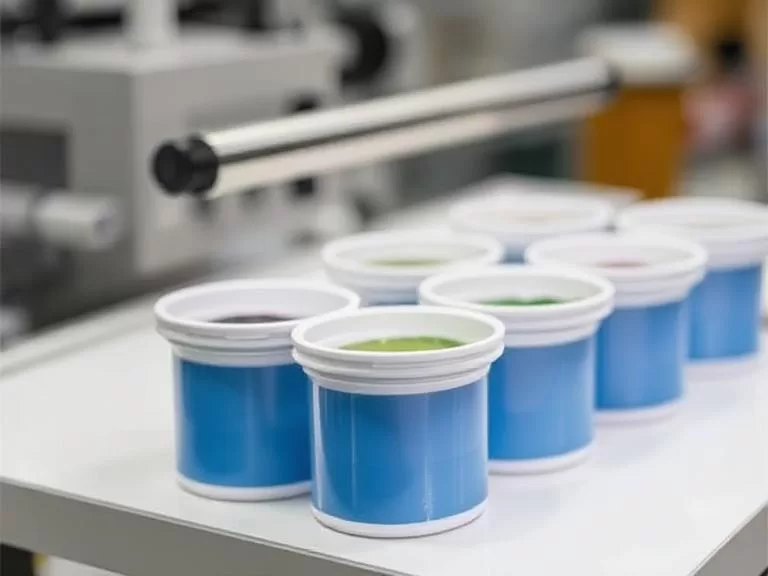
Deciding How much master batch to add when utilizing a 着色母粒 depends strictly on the tinting strength of the pigments and the specific carrier resin. The carrier resin of the additive must possess a higher melt flow rate than the base polymer to ensure the pigment disperses seamlessly before reaching the extrusion die.
From our experience, creating a flawless visual aesthetic requires rigorous volumetric or gravimetric feeding. If you are blending manually or using outdated volumetric feeders, the distribution of pellets will be inconsistent, leading to color banding. We recommend integrating gravimetric dosers that automatically calculate How much master batch to add based on the real-time weight of the base resin entering the throat of the extruder. For standard custom colors, a dosage rate of 2 percent to 3 percent provides a stable, repeatable hue across continuous production shifts.
4. Evaluating How much master batch to add for Functional Applications
While color additives are primarily evaluated visually, functional additives require strict adherence to chemical concentration thresholds to pass international safety and performance standards. The calculus for How much master batch to add shifts dramatically when processing a Functional Masterbatch.
Antimicrobial and Antistatic Dosing
For medical devices, food packaging, and hygienic surfaces, Antimicrobial and Antistatic additives are non-negotiable. Antistatic agents work by migrating to the surface of the polymer to attract ambient moisture, creating a conductive layer that dissipates static electricity. Determining How much master batch to add for antistatic properties depends on the ambient humidity of the final product’s operating environment. Typically, a dosage of 1.5 percent to 3 percent is required. If you underdose, the static decay time will fail to meet safety specifications; if you overdose, the migrating additive will cause a greasy surface residue that ruins printability.
Flame Retardant and UV Stabilizer Calibration
When specifying a Flame Retardant, safety is paramount. Products required to pass the stringent UL94 V-0 flammability standard demand high concentrations of halogenated or halogen-free active ingredients. Therefore, you must significantly increase How much master batch to add. It is not uncommon for flame retardant LDRs to range from 5 percent to as high as 15 percent. Because this high volume displaces a significant amount of the base polymer, you must carefully monitor the tensile strength and impact resistance of the final part.
Similarly, calculating How much master batch to add for a UV stabilizer depends entirely on geographic deployment. Agricultural films exposed to intense equatorial sun require a higher dosage (3 percent to 5 percent) of hindered amine light stabilizers (HALS) compared to products used in temperate, indoor environments. Our individual development cooperation ensures that we analyze your exact geographic and regulatory requirements to recommend the precise LDR.
5. Application-Specific Dosing Requirements
The structural demands of your manufacturing process dictate strict boundaries on How much master batch to add.
Fiber / Filament / BCF / Nonwoven
In the textile sector, specifically the production of Fiber / Filament / BCF / Nonwoven materials, dispersion is critical. A single microscopic agglomeration of un-dispersed pigment will cause the spinneret to clog or the ultra-fine filament to snap under tension, resulting in costly downtime. When determining How much master batch to add for fibers, you are severely limited. High dosages can disrupt the polymer’s crystalline structure during the drawing process. Therefore, we utilize advanced twin screw machines from Germany to create hyper-dispersed concentrates, allowing our clients to use incredibly low dosage rates (1 percent to 2 percent) while maintaining brilliant color saturation and absolute filament integrity.
Film / Plastic Packaging
In the Film / Plastic sector, particularly blown film extrusion, the requirements shift. The goal is to maintain the bubble stability while achieving the desired opacity and barrier properties. When engineering multi-layer films, operators must calculate How much master batch to add for each specific layer. Often, heavy pigmentation is restricted to the core layer, allowing the outer skin layers to remain pure for maximum sealability. For standard single-layer films, an LDR of 3 percent to 5 percent is common to prevent light degradation of the packaged goods.
6. The Role of Dispersion Technology in Dosage
Ultimately, the question of How much master batch to add is tied directly to the manufacturing quality of the additive itself. Poorly manufactured masterbatches contain clumps of raw pigment that fail to melt and distribute evenly. To compensate for this poor tinting strength, operators are forced to increase the dosage, driving up raw material costs and inducing mechanical flaws in the plastic.
At Charming Masterbatch, we solve this at the molecular level. Utilizing advanced twin screw machines from Germany, our intense shear processing ensures that every single pigment particle is fully encapsulated by the carrier resin. This superior dispersion technology means our clients can frequently reduce How much master batch to add by up to 20 percent compared to competitor products, yielding significant financial savings without compromising on vibrance or functional performance. We provide complete technical support service to calibrate your feeding equipment to these optimized ratios.
7. Summary Table: Standard LDR Guidelines
To assist process engineers in rapid calculation, we have compiled a summary matrix detailing the standard recommendations for How much master batch to add across various applications.
| Application / Additive Type | Typical Product Example | Recommended Dosage (LDR) | Primary Engineering Concern |
|---|---|---|---|
| Injection Molding (Thick Wall) | Automotive parts, heavy crates | 1.0% – 2.0% | Minimal opacity issues; focus on uniform color distribution. |
| Blown Film (Thin Wall) | Shopping bags, agricultural film | 3.0% – 6.0% | High transmission of light requires higher pigment load. |
| Fiber / Filament / BCF | Carpet yarn, nonwoven textiles | 1.0% – 2.5% | Filter pressure value (FPV); preventing filament breakage. |
| UV Stabilizer | Outdoor furniture, greenhouse film | 2.0% – 5.0% | Geographic UV index and required outdoor lifespan in months. |
| 阻燃剂 | Electrical housings, construction | 5.0% – 15.0% | Meeting strict UL94 V-0 standards while maintaining impact strength. |
| Antistatic Agent | Electronic packaging, medical films | 1.5% – 3.0% | Surface migration rate and ambient operational humidity. |
8. Frequently Asked Questions (FAQs)
What happens if I calculate How much master batch to add incorrectly and overdose the polymer?
Overdosing is a common error that leads to severe mechanical degradation. If you miscalculate How much master batch to add, the excess carrier resin and pigment will disrupt the tensile and impact strength of the base polymer. It can also cause “plate-out” on the extrusion die and screw slippage, bringing production to a halt.
How much master batch to add if I am mixing recycled regrind with virgin resin?
From our experience, when utilizing recycled regrind, the base color is often dark or inconsistent. You must increase How much master batch to add to effectively mask the variations in the regrind. We recommend starting with a 3 percent to 4 percent LDR and conducting a visual opacity test before running full production.
Why do fibers require such a low calculation of How much master batch to add?
Spinning fibers involves drawing the polymer through microscopic spinneret holes under extreme tension. If you evaluate How much master batch to add and choose a high dosage, the massive amount of pigment particles will act as stress concentrators, causing the delicate threads to snap. High dispersion allows for low dosages to prevent this.
Does the carrier resin affect How much master batch to add?
Absolutely. The carrier resin of the additive must be compatible with your base polymer (e.g., a PE carrier for a PE film). If the carrier has a significantly different melt temperature, you must adjust How much master batch to add carefully, or risk un-melted gels appearing as structural flaws in your final product.