
The plastics extrusion industry is entirely unforgiving, and nowhere is this more evident than in the production of Biaxially Oriented Polypropylene (BOPP) films. When you stretch a polymer film in two directions simultaneously down to thicknesses of 10 to 50 microns, the margin for error is absolutely zero. Any microscopic impurity, poor dispersion, or incompatible carrier resin will result in instantaneous web breaks, costing your facility thousands of dollars in lost production time and wasted raw materials.
From our experience working with top-tier film manufacturers worldwide, the fundamental misunderstanding of what bopp masterbatchs actually are is the leading cause of poor film quality. Many procurement managers make the critical error of treating all polypropylene additives as interchangeable commodities. They are not. If you are feeding standard injection-molding masterbatches into a high-speed Bruckner or Brückner BOPP line, you are actively sabotaging your own machinery. This comprehensive guide cuts through the technical jargon to explain what these specific masterbatches are, how they function under extreme mechanical stress, and how to make a financially sound buying decision for your production facility.
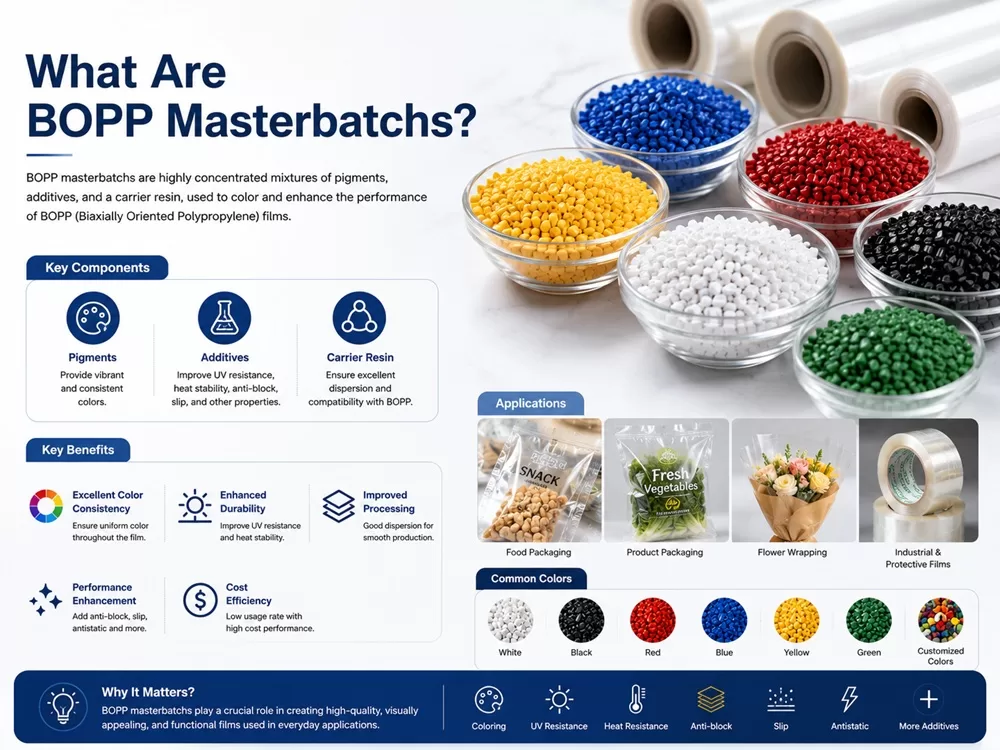
Quick Answer: What Are BOPP Masterbatchs?
BOPP masterbatchs are highly specialized, ultra-dispersed polymer concentrates used exclusively in the manufacturing of Biaxially Oriented Polypropylene films. They consist of pigments or functional additives (like anti-block, slip, or anti-static agents) encapsulated in a highly specific homopolymer or copolymer carrier resin.
Unlike general-purpose masterbatches, BOPP masterbatchs are engineered to withstand extreme bi-directional stretching without creating voids, gels, or die lip buildup. If you are producing flexible packaging, adhesive tapes, or capacitor films, utilizing dedicated BOPP-grade masterbatches is the only way to ensure uninterrupted, high-speed production.
Table of Contents
- Direct Answer: What is a BOPP Masterbatch?
- How It Works: Surviving the Tenter Frame
- Quick Summary Table
- Commercial and Technical Benefits
- Limitations and Production Risks
- Pros vs Cons Table
- Who Should Use It & Who Does Not Need It
- Common Mistakes in Production
- Comparison: BOPP vs Standard PP
- Buying Considerations
- Buying Guide Table
- Expert Recommendation
- Frequently Asked Questions
Direct Answer: What is a BOPP Masterbatch?
To understand the product, you must first understand the base material. If you review what is PP masterbatch, you will note it is designed for general polypropylene applications. However, bopp masterbatchs are a completely different class of chemical engineering. They are premium-grade concentrates designed specifically for films that will be stretched in both the Machine Direction (MD) and the Transverse Direction (TD).
These masterbatches are formulated to deliver either color (such as highly opaque white for pearlized films) or functionality (such as slip agents to reduce the coefficient of friction) without interfering with the crystalline structure of the oriented polypropylene. The carrier resin used in a BOPP masterbatch must have a melt flow index (MFI) that perfectly matches the base resin of the film. If the rheology is mismatched, the film will delaminate or snap during the stretching phase.
How It Works: Surviving the Tenter Frame
In most professional situations, producing BOPP film involves melting the polymer, casting it onto a chill roll to form a thick sheet, heating it again, stretching it longitudinally through a series of rollers, and finally stretching it laterally inside a massive oven called a tenter frame. For a deeper understanding of the chemical makeup required to survive this, consult a reliable masterbatch composition guide.
How a BOPP masterbatch works is entirely dependent on dispersion. When the thick sheet is stretched to 1/40th of its original thickness, any clump of undispersed pigment larger than 5 microns will act as a stress concentrator. As the film stretches around this microscopic clump, a hole forms. In the high-tension environment of a tenter frame, that microscopic hole instantly tears across the entire web, causing a catastrophic machine shutdown. BOPP masterbatchs work by utilizing premium wetting agents and advanced twin-screw compounding to ensure the additive particles are milled down to sub-micron sizes and perfectly distributed throughout the carrier resin.
Quick Summary Table: Key Specifications
| Specification | Requirement for BOPP Masterbatchs | Why It Matters |
|---|---|---|
| Carrier Resin | High-purity Homopolymer or Random Copolymer PP | Must match the base film to prevent optical defects and delamination. |
| Dispersion Level | Sub-micron particle size distribution | Prevents stress concentrators that cause web tearing during biaxial stretching. |
| Filter Pressure Value (FPV) | Extremely Low (typically < 1 bar/g) | Ensures fine screen packs in the extruder do not clog, maintaining continuous production. |
| Thermal Stability | High (up to 300°C) | Prevents additive degradation and die drool during high-speed, high-temperature extrusion. |
Commercial and Technical Benefits
For commercial users, the benefits of investing in dedicated BOPP-grade masterbatches are directly tied to machine uptime and product yield.
- Continuous Uptime: High-quality dispersion eliminates filter blinding. You can run your extrusion line for weeks without needing to stop and change screen packs, drastically increasing your total output.
- Optical Perfection: Whether you are producing transparent tape films or highly opaque snack packaging, premium masterbatches ensure zero “gels” or “fish-eyes” on the film surface, allowing you to sell your product at top-tier market prices.
- Consistent Functionality: Functional masterbatches (anti-static, slip, anti-fog) migrate to the surface of the film at a highly controlled, predictable rate, ensuring that the film processes perfectly on downstream printing and packaging machines.
Limitations and Production Risks
We believe in commercial reality. The primary limitation of true bopp masterbatchs is the cost. Because they require premium carrier resins, extensive milling, and rigorous quality control testing (like FPV analysis), they are significantly more expensive per kilogram than standard commodity masterbatches. You cannot treat this as a budget-cutting area.
Furthermore, they require exact dosage control. If your gravimetric blenders are out of calibration and you overdose a slip masterbatch, the film will become too slippery to wind properly, leading to telescoping rolls that must be scrapped.
Pros vs Cons Table: Premium BOPP Masterbatchs
| Pros (Commercial Advantages) | Cons (Operational Limitations) |
|---|---|
| Eliminates costly web breaks and machine downtime. | Higher initial purchasing cost per kilogram. |
| Provides flawless optical clarity and opacity. | Requires highly precise gravimetric dosing equipment. |
| Prolongs the life of extruder screen packs. | Inventory must be carefully managed to avoid cross-contamination. |
| Ensures downstream printing and converting success. | Specific formulations required for specific film structures (e.g., skin layer vs core layer). |
Who Should Use It & Who Does Not Need It
For commercial users: Any facility operating a dedicated BOPP, BOPET, or BOPA film line must exclusively use oriented-film-grade masterbatches. This includes manufacturers of food packaging, adhesive tapes, floral wraps, synthetic paper, and capacitor films. Partnering with the color masterbatch manufacturers 2025 leaders who specialize in film extrusion is non-negotiable.
Who does not need it: If your facility primarily runs thick-walled injection molding, blow molding for rigid containers, or standard thick profile extrusion, purchasing BOPP masterbatchs is a massive waste of capital. The extreme dispersion standards required for a 15-micron film are completely unnecessary for a 3-millimeter thick plastic bucket.
Common Mistakes in Production
In our testing and facility audits, we see plant managers make the same catastrophic errors repeatedly:
- Substituting Blown Film Masterbatch for BOPP: A masterbatch that works perfectly in a standard PE blown film line will destroy a BOPP line. Blown film only stretches slightly compared to the extreme orientation of a tenter frame. Never substitute these materials.
- Ignoring Moisture Content: BOPP masterbatchs must be bone dry. If the masterbatch absorbs humidity during storage and is fed into the extruder without pre-drying, the moisture turns to steam, creating micro-voids in the melt that lead to immediate web breaks.
- Purchasing on Price Alone: Buying from unverified suppliers to save ten cents a kilo inevitably leads to thousands of dollars in scrapped film due to die lip buildup (die drool) caused by cheap waxes and poor dispersion. Always vet your suppliers through reliable lists, such as the best plastic masterbatch manufacturers.
Comparison Table: BOPP vs Standard PP Masterbatchs
| Feature | BOPP Masterbatchs | Standard PP Masterbatchs |
|---|---|---|
| Target Application | Biaxially oriented films (10-50 microns) | Injection molding, thick extrusion, raffia |
| Dispersion Requirement | Absolute perfection (Sub-micron) | Moderate to Good |
| Filter Pressure Value (FPV) | Critical metric; must be near zero | Rarely tested; often high |
| Carrier Resin Formulation | Highly specific to the film layer (Homopolymer/Terpolymer) | Generic Polypropylene |
| Cost Profile | Premium Pricing | Commodity Pricing |
Buying Considerations
When you are ready to place a purchase order, your buying advice must be rooted in technical data. You must demand the Certificate of Analysis (COA) for every batch. Look specifically for the Filter Pressure Value (FPV) and the moisture content. If you are sourcing black pigment for agricultural or specialized packaging films, reviewing what is carbon black masterbatch in the context of film extrusion will reveal that finding a high-jetness black with low FPV is incredibly difficult and requires a master compounder.
Buying Guide Table: Selecting Functional BOPP Additives
| Additive Type | Primary Function | Buying Consideration |
|---|---|---|
| White (TiO2) Masterbatch | Opacity and whiteness for labels/packaging | Ensure the TiO2 is heavily coated to prevent die wear and lacing. |
| Anti-Block Masterbatch | Prevents film layers from sticking together on the roll | Choose synthetic silica over natural talc for superior optical clarity (low haze). |
| Slip Masterbatch | Lowers the Coefficient of Friction (COF) for packaging machines | Specify migrating vs non-migrating slip depending on your printing requirements. |
| Anti-Static Masterbatch | Dissipates static charge to prevent dust attraction | Ensure compatibility with your local climate, as many rely on ambient humidity to function. |
Expert Recommendation
Why Sourcing Matters
From our experience, the success of a BOPP film line is entirely dependent on the integrity of the raw materials fed into the hopper. You cannot out-engineer a poorly dispersed masterbatch. If you are looking to upgrade your supply chain, evaluating plastic masterbatch manufacturers USA or global leaders is the first step toward operational stability.
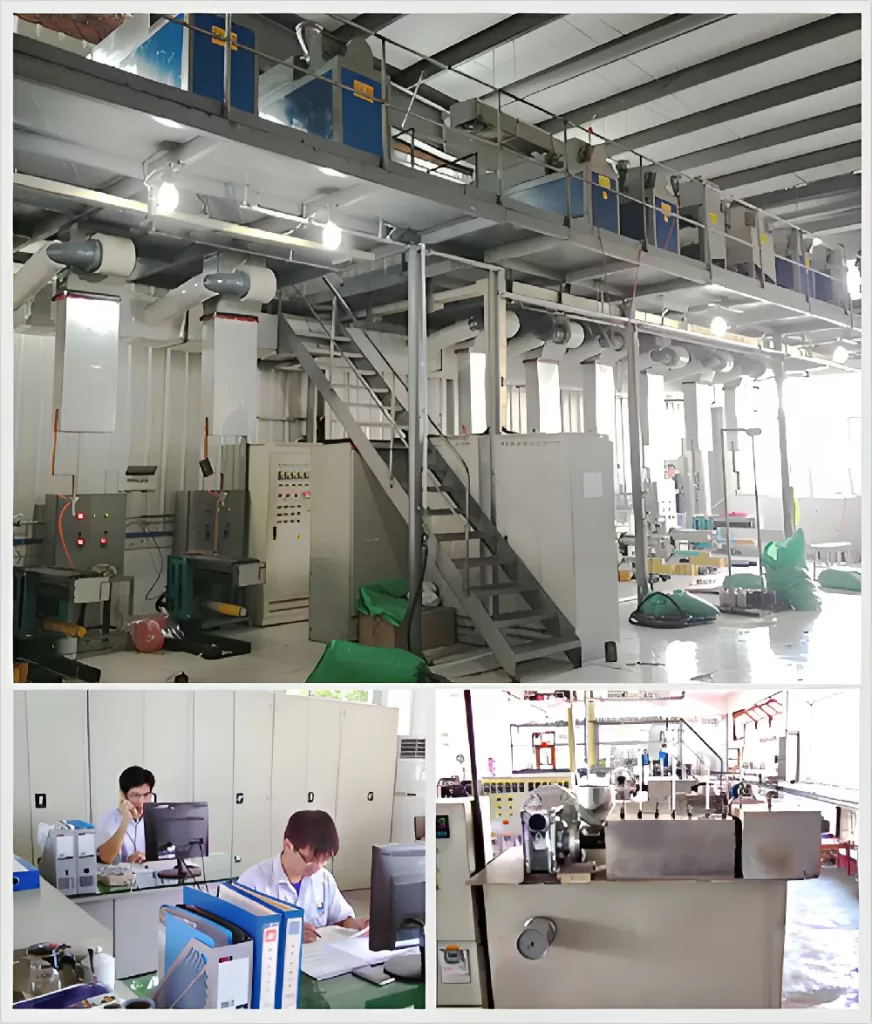
Charming Masterbatch is well known in the China market, and exports to Europe, South America, Southeast Asia, the Middle East, North Africa, and about 18 countries and markets worldwide. Not only products, Charming provides complete technical support service and individual development cooperation, which can help our customers solve practical problems and develop new projects with creative solutions. We strongly recommend partnering with a manufacturer like Charming that views masterbatch production not as a bulk commodity, but as a precise chemical science. For heavy-duty film applications, it is absolutely worth paying the premium for guaranteed quality.
Frequently Asked Questions (FAQ)
What are bopp masterbatchs used for?
BOPP masterbatchs are specifically engineered additives and colorants used in the production of Biaxially Oriented Polypropylene films. They are used to impart color, opacity, anti-static properties, slip resistance, or anti-blocking characteristics to thin packaging films without causing web breaks during the high-speed stretching process.
Can I use standard PP masterbatch for BOPP film extrusion?
No. In most professional situations, using a standard PP masterbatch in a BOPP line will lead to catastrophic production failures. Standard masterbatches lack the ultra-fine dispersion and specific carrier resins required to survive the extreme mechanical stretching in both the machine and transverse directions.
Why is filter pressure value (FPV) important for BOPP masterbatchs?
Filter Pressure Value (FPV) measures the dispersion quality of the masterbatch. A high FPV indicates large agglomerates of pigment or additives. In BOPP film production, these agglomerates cause filter clogging, die lines, and film tearing. A premium BOPP masterbatch must have a very low FPV to ensure continuous, flawless production.
Authoritative References & Industry Standards
To ensure your manufacturing processes align with global quality and safety standards, we recommend reviewing the guidelines published by the following authoritative organizations:
- International Organization for Standardization (ISO) – Specifically ISO 1133 for determining the melt mass-flow rate (MFR) and melt volume-flow rate (MVR) of thermoplastics.
- ASTM International – Standards for plastics testing, including ASTM D3236 for apparent specific gravity and D1003 for haze and luminous transmittance of transparent plastics.
- Plastics Industry Association (PLASTICS) – Providing comprehensive guidelines on processing protocols and material handling for continuous film extrusion operations.