
Authored by the polymer engineering team at Charming Masterbatch. With advanced twin screw machines from Germany and decades of experience in Masterbatch processing and pigment dispersion technology, Charming provides stable high quality color Masterbatch and creative functional Masterbatch solutions for our customers. Charming Masterbatch is well known in the China market, and exports to Europe, South America, Southeast Asia, Middle East, North Africa and approximately 18 countries and markets worldwide. Not only products, Charming provides complete technical support service and individual development cooperation, which can help our customers solve practical problems and develop new projects with creative solutions. We are so proud that we can share our experience and technology with customers and grow up together.
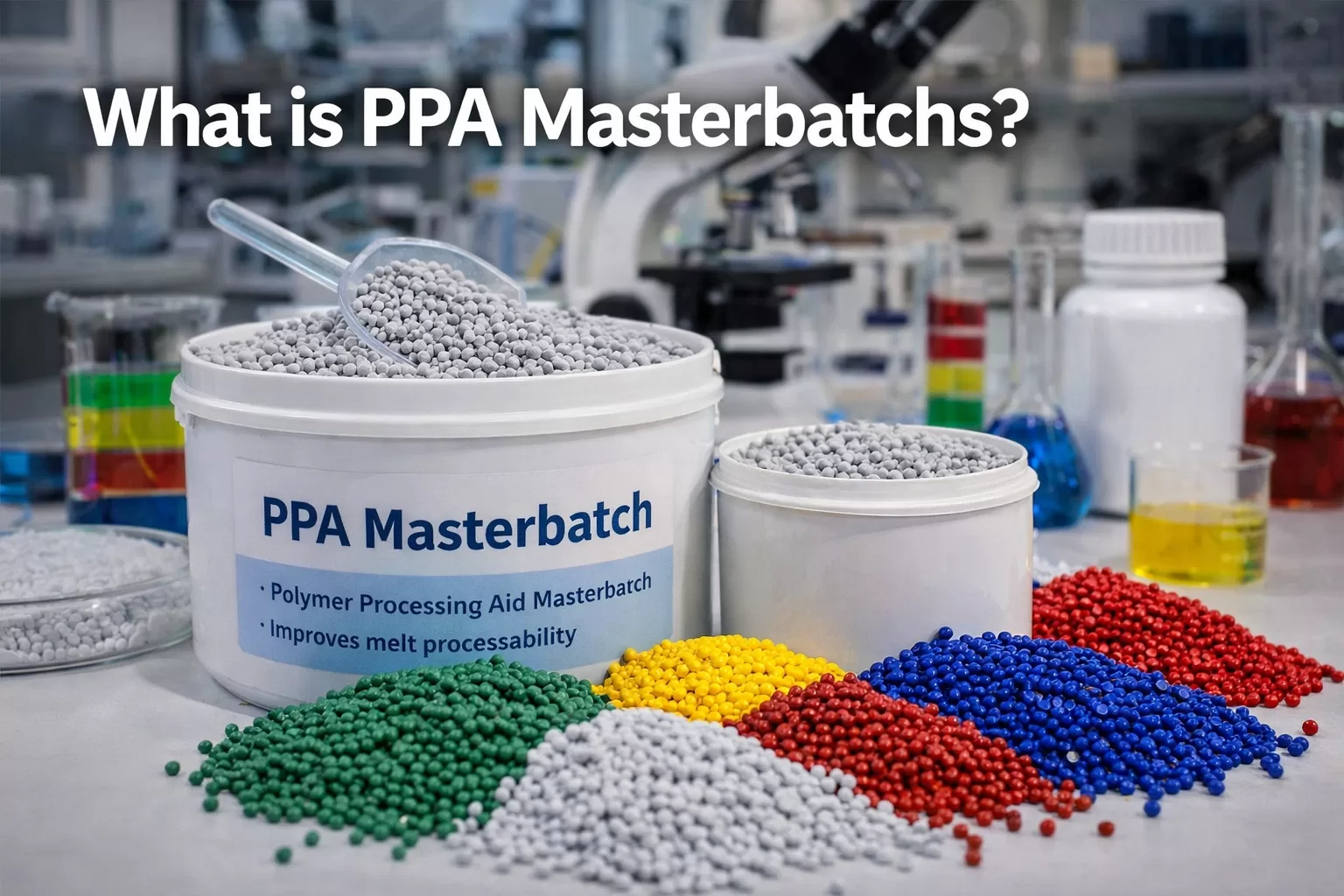
In the highly exact field of polymer extrusion and plastics manufacturing, maintaining a flawless surface finish while simultaneously maximizing production throughput is an ongoing engineering challenge. Processing high-viscosity polymers, particularly linear low-density polyethylene (LLDPE) and high-density polyethylene (HDPE), frequently results in severe rheological defects. These defects manifest as surface roughness, melt fracture (often referred to as sharkskin), and heavy die drool build-up. To counteract these phenomena without fundamentally altering the base polymer structure, industry professionals rely on highly specialized chemical formulations. Chief among these solutions is the ppa masterbatch.
From our experience supplying advanced polymer solutions to global markets, understanding exactly what a ppa masterbatch does on a molecular and mechanical level is critical for any extrusion facility manager. PPA stands for Polymer Processing Additive. When a ppa masterbatch is introduced into the extrusion process, it radically alters the flow dynamics of the molten polymer against the metallic surfaces of the extrusion die. In this comprehensive technical manual, we will dissect the chemical mechanics of a ppa masterbatch, outline its primary benefits in film and fiber production, and explain how to seamlessly integrate it into your existing manufacturing workflow.
Table of Contents
- 1. The Chemical Breakdown: What is PPA Masterbatch?
- 2. Mechanism of Action Inside the Extruder
- 3. Key Benefits of Using PPA Masterbatch
- 4. Primary Applications in Plastics Manufacturing
- 5. Integrating PPA with Other Functional Masterbatches
- 6. Summary Table: PPA Masterbatch Advantages
- 7. Frequently Asked Questions (FAQs)
- 8. Industry References
1. The Chemical Breakdown: What is PPA Masterbatch?
To accurately answer the question of what is a ppa masterbatch, we must look at its active ingredients. A ppa masterbatch is essentially a carrier resin heavily loaded with fluoropolymer-based additives. Fluoropolymers possess an exceptionally low surface energy and an extremely low coefficient of friction. When formulated into a masterbatch, these fluoropolymers are dispersed evenly within a carrier resin that is highly compatible with the host polymer being extruded (such as PE or PP).
Unlike other additives that seek to alter the bulk properties of the entire plastic mass, a ppa masterbatch is designed to migrate. Because fluoropolymers are incompatible with polyolefins, the active PPA particles are naturally pushed to the outside of the molten polymer mass as it travels through the heated extruder barrel. This controlled incompatibility is the core scientific principle that makes a ppa masterbatch so incredibly effective.
2. Mechanism of Action Inside the Extruder
Understanding the mechanical action of a ppa masterbatch requires visualizing the extrusion die. Under normal conditions, when a highly viscous polymer is forced through a narrow metal die gap, severe shear stress occurs at the polymer-metal interface. The polymer sticks to the wall of the die, causing the center of the melt stream to flow much faster than the edges. When the polymer finally exits the die, this velocity differential causes the material to snap back, creating the rough, scaly surface known as melt fracture.
When you dose a ppa masterbatch into the hopper, the migrating fluoropolymers rapidly coat the internal metallic surfaces of the extrusion die. From our experience, this coating process creates a microscopic, dynamic lubricating layer. The molten plastic no longer sticks to the steel; instead, it slips effortlessly over the fluoropolymer coating. This slip-stick transition equalizes the velocity profile of the melt stream, entirely eliminating the shear stress that causes surface defects. It is important to note that a ppa masterbatch does not permanently alter the chemistry of the final plastic product; it merely acts as a temporary, highly localized processing aid.
3. Key Benefits of Using PPA Masterbatch
Integrating a high-quality ppa masterbatch into your production lines yields immediate and measurable operational improvements. We recommend evaluating the following three primary benefits when calculating your return on investment.
Elimination of Melt Fracture and Sharkskin
The most immediate visual benefit of a ppa masterbatch is the total eradication of sharkskin. For producers of clear packaging films, surface roughness destroys optical clarity and prints poorly. By eliminating melt fracture, a ppa masterbatch ensures that blown and cast films possess a brilliant gloss, supreme clarity, and a flawlessly smooth surface texture, meeting the highest retail packaging standards.
Reduction of Die Drool and Build-Up
During prolonged extrusion runs, degraded polymer, low-molecular-weight waxes, and pigment agglomerates tend to accumulate on the lip of the die. This is known as die drool. Eventually, these hardened accumulations break off and embed themselves into the final product, causing immediate quality control failures. The continuous fluoropolymer coating provided by a ppa masterbatch prevents these materials from adhering to the die lip. This drastically extends the continuous operation time of the machine, reducing costly maintenance shutdowns and minimizing scrap rates.
Temperature and Energy Optimization
Because a ppa masterbatch massively reduces the friction between the polymer melt and the extruder barrel, the backpressure within the system drops significantly. This reduction in pressure allows manufacturers to lower their processing temperatures or increase the RPM of their extruder screws without overloading the motor. Consequently, utilizing a ppa masterbatch results in either higher production output per hour or a notable reduction in overall electrical energy consumption.
4. Primary Applications in Plastics Manufacturing
A ppa masterbatch is not limited to a single sector of the plastics industry. Its friction-reducing properties are universally beneficial across multiple extrusion disciplines.
Film / Plastic Extrusion: In the production of agricultural films, stretch wrap, and heavy-duty shipping sacks, LLDPE is the polymer of choice due to its puncture resistance. However, LLDPE is notoriously difficult to process. Adding a ppa masterbatch to the Film / Plastic formulation allows for the use of narrower die gaps, enabling the production of thinner, stronger films at much higher extrusion speeds.
Fiber / Filament / BCF / Nonwoven: The production of synthetic textiles demands absolute precision. When extruding ultra-fine denier fibers, any melt instability will cause the fiber to snap, halting the entire spinning process. By incorporating a ppa masterbatch into the Fiber / Filament / BCF / Nowoven production line, manufacturers achieve a highly stable melt stream. This reduces filament breakage, enhances the tensile strength of the fiber, and ensures a smoother tactile feel in the final nonwoven fabric.
5. Integrating PPA with Other Functional Masterbatches
At Charming Masterbatch, we engineer our solutions to work in synergy. A standard production run rarely relies on a single additive. We recommend a holistic approach to polymer formulation.
A high-performance ppa masterbatch is fully compatible with our extensive line of Functional Masterbatch products. For instance, when manufacturing outdoor agricultural films, a ppa masterbatch can be seamlessly combined with our 抗UV老化 masterbatch to ensure smooth processing and long-term sun resistance. For specialized electronic packaging, combining a ppa masterbatch with our 抗静电 masterbatch ensures a flawless surface finish while preventing static electricity accumulation.
Furthermore, building materials such as extruded pipes or wire cabling often require rigorous safety profiles. Our ppa masterbatch will not interfere with the efficacy of our 阻燃剂 additives. Similarly, for medical or food-contact plastics, you can safely process our 抗菌防霉 masterbatch alongside a PPA without cross-contamination or degradation of active properties. Finally, whether you are running a custom shade from our 着色母粒 division or a standard opaque white, the inclusion of a ppa masterbatch actually improves pigment dispersion by maintaining a consistent, low-shear flow environment.
6. Summary Table: PPA Masterbatch Advantages
To assist procurement managers and polymer engineers, we have compiled the core operational advantages of integrating a ppa masterbatch into standard extrusion workflows.
| Operational Challenge | PPA Masterbatch Solution | Resulting Benefit |
|---|---|---|
| Sharkskin / Melt Fracture | Coats die wall with low-friction fluoropolymers. | Produces high-gloss, optically clear, smooth films and pipes. |
| Die Drool / Lip Build-Up | Prevents degraded polymer adhesion at the die exit. | Extends continuous run times and drastically reduces scrap rates. |
| High Extruder Backpressure | Reduces overall shear stress and friction in the barrel. | Lowers energy consumption and extends the lifespan of the extruder motor. |
| Low Production Output | Slip-stick transition allows for faster melt flow. | Increases line speed and hourly production volume without raising temperatures. |
| Poor Pigment Dispersion | Stabilizes the melt flow environment. | Enhances the uniformity and vibrance of the accompanying Color Masterbatch. |